Considering different Automated public transport forms in rural areas in the Netherlands weighing societal, user, and business needs: A Future Vision.
Mar 2026 - ongoing
Arranging public transport in rural areas is a challenge to regional governments. Often leading to less connections and a lower frequency for public transportation compared to more densely populated areas. The implementation of autonomous transport in rural areas has great potential. With possibilities to make the service more flexible, on demand and to lower personnel costs. Some autonomous shuttles already exist for some time (Like the ‘ParkShuttle Rivium’), and others are currently being piloted (Airport bus Rotterdam). But large scale implementation is not yet a reality.
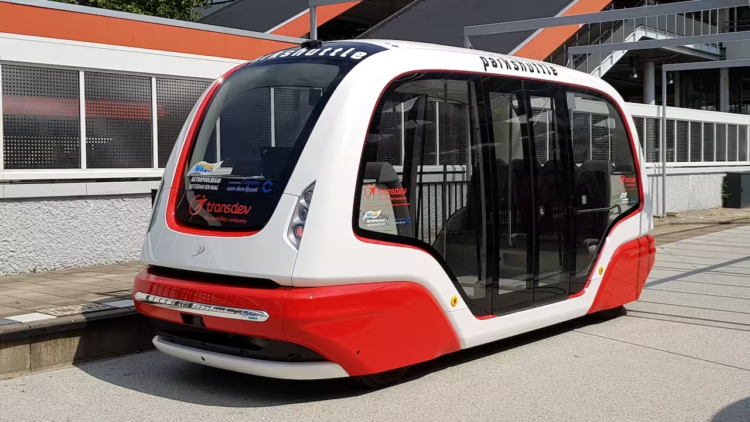
Currently automated mobility solution developments are mainly driven by a technology push form industry, but the blind implementation of all autonomous solutions can potentially lead to negative societal effects. For instance, an increase in congestion, or a further reduction of physical movement.
This graduation assignment focuses on defining and balancing the societal, user, and business needs for public transport in rural areas. One of the activities will entail exploring the societal and user needs and map out where these needs collide or where they coincide. The core challenge is to identify the ‘sweet spot’, a solution where the profit is largest for both society and users, while also forming a future vision of what this service could look like.
The assignment does not involve a specific client, but in collaboration with the Automated Mobility Lab the opportunity can be created to get input from relevant stakeholders such as regional operators and regional governments.
Are you a SPD or DFI student?
With an interest in mobility and public transport?
And interested in future vision creation for a societal relevant topic?
This is your graduation project!
Are you interested?! Contact Gerbera Vledder for more information
There is no specific starting date for this project!