Improving family-centered care through designing for perspective changes
Sep 2024 - ongoing
Successful care and support within child and adolescent psychiatry requires collaboration with all parties involved: the child/adolescent, parents or caregivers, other family members, healthcare professionals , and the wider system around the family. Yet, such collaboration remains difficult. It is influenced by both the direct actors involved as well as systemic influences. This research project aims to explore the experiences of families and healthcare professionals, to collaboratively and iteratively design an intervention to improve the care trajectory.
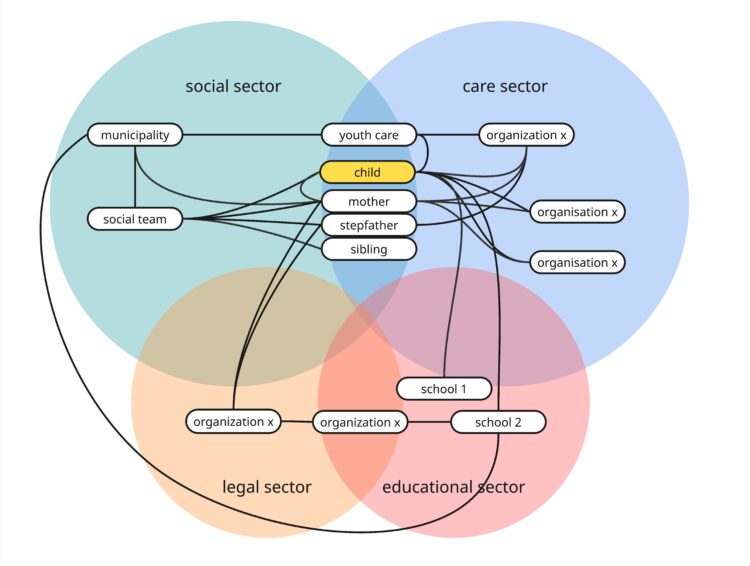
A good relationship is the foundation of good care. However, care relationships are fragile, situated, and emotionally charged. The relationships between healthcare professionals and families are full of tensions around hidden emotions, unshared stories and unequeal power distributions. Furthermore, this relationship is influenced by the wider system in the form of previous care interactions, future care providiers missing in the collaboration, demands from the system with regards to classificants and diagnoses, and work pressure.
The situated experiences of families and healthcare professionals, and the intricaies of their interactions are explored via ethnographic research using design approaches. Visual and generative tools form the means to participate with the actors in understanding what happens and imagining new futures. These tools support in zooming in and out to different levels of the system: from inside the individual to the national mental health system. The goal is to explore where opportunities are to improve the relationships between the actors, since in relating they are forming the system. Systems exist of relationships, and enabling new relationships can thereby be a means to provide agency to the actors to start changing the system from the inside out.